
In fact, the primary objective of this work is to model several two-party cryptographic protocols as two-person video games in order to introduce the human issue in the evaluation of cryptographic protocols so that it could be helpful to resolve many safety issues that are exhausting to deal with conventional safety primitives. The verification of cryptographic protocols has turn into a subjectof nice significance with the event of communications andtransactions on public channels like Web. Since Cryptologymay be seen as a continuous struggle between cryptographers andcryptanalysts, and Game Principle may be defined because the study ofdecision making in difficult situations, each fields appear to havecertain common scenarios, so it is pure that tools from onearea could also be applied within the different. In reality, the main goal ofthis work is to mannequin a quantity of two-party cryptographic protocols astwo-person video games in order to introduce the human factor in theanalysis of cryptographic protocols so that it may be helpful tosolve many safety problems which are hard to deal withtraditional security primitives. «Cryptography» is the follow and examine of methods for securing communication and knowledge by remodeling it right into a format that’s unreadable to unauthorized customers. It encompasses numerous strategies, together with encryption, decryption, hashing, and digital signatures, to ensure confidentiality, integrity, authenticity, and non-repudiation of knowledge NIST-SP .

Ssl/tls (secure Sockets Layer / Transport Layer Security)
Diffie-Hellman is the classic method and the historical breakthrough that made sensible secure key settlement possible at scale. Elliptic Curve Diffie-Hellman makes use of elliptic curve cryptography to achieve the same type of change with smaller keys and higher effectivity. Both are still broadly used underneath the hood in TLS, VPNs, and safe messaging techniques.
European Symposium On Analysis In Laptop Safety, 2008
As technology evolves, the development of extra sturdy and scalable cryptographic protocols might be essential to deal with rising challenges and ensure the security of the digital economy. This doc provides a concise, sensible and standards-aligned reference for standardized cryptographic algorithms and their beneficial utilization in different contexts. It provides pointers on when and the way to use particular algorithms, parameter selections, and common pitfalls to keep away from, in order to promote a consistent http://www.greensboring.com/2017/02/information-asymmetry.html, standards-based, and safe use of cryptography across web applied sciences. Cryptographic algorithms, when utilized in networks, are used within a cryptographic protocol. A quick overview is introduced on protocols that are utilized in comparatively restricted software areas corresponding to wi-fi, cell communications or banking (Bluetooth, WPA/WEP, UMTS/LTE, ZigBee, EMV) and specific environments focusing on Cloud computing. Another misconception is that once a shared secret is established, the communication is mechanically secure.
71 Password-based Key Derivation Capabilities (pbkdfs)
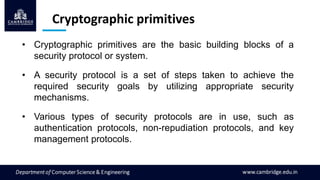
Cryptographic protocols play an important role in ensuring the security of sensitive data, such as financial transactions, private information, and communication between units. By utilizing sturdy encryption algorithms and secure key trade mechanisms, cryptographic protocols defend data from eavesdroppers, hackers, and other malicious actors. A cryptographic key exchange protocol is a set of procedures that enable two events to securely set up a shared secret over an insecure communication channel. Cryptographic protocols are sets of rules and procedures that govern the safe communication between two or extra parties over a community. These protocols use various cryptographic techniques similar to encryption, hashing, and digital signatures to make sure the confidentiality, integrity, and authenticity of the information being transmitted. One of probably the most used MAC is HMAC (Hash-based Message Authentication Code), which is standardized in FIPS-198-1 and RFC2104.
- To achieve consumer authentication, varied strategies can be employed, including something the consumer knows (e.g., password), something the consumer has (e.g., security token), or something the user is (e.g., biometric data).
- Some SDOs concentrate on defining the algorithms and protocols themselves, whereas others present recommendations and greatest practices for their implementation in varied applications.For instance, W3C supplies standards and tips for implementing cryptographic mechanisms in web technologies however does not standardize new cryptographic algorithms.
- Signature aggregation methods (Schnorr, BLS) reduce transaction sizes in multi-sig eventualities.
- The necessary half is that an attacker can see the basic public values however still shouldn’t be capable of calculate the shared secret.
- The major aspect of ECDH is the choice of the elliptic curve used; probably the most broadly used and beneficial curves are the NIST curves P-256 (with 128 security bits), P-384, and P-521 (with 256 security bits) also known as Secp256r1, Secp384r1, and Secp521r1, respectively, and standardized in FIPS-186-5.
If a protocol family turns into out of date, you want a clean path to switch it without redesigning the entire environment. Start by checking whether the architecture makes use of modern, supported protocols as an alternative of legacy options. If an old protocol remains to be enabled for compatibility, it ought to be a deliberate exception with documented danger, not a default that no one remembers to take away. The CISA steerage on secure configuration and identity-centric defense is a practical complement when reviewing real deployments.
Comentarios recientes